Human-Brain Enhancement: Redefining Intelligence


People often wonder how they could become smart within a short period of time. For centuries, it seemed impossible to do so. However, in the near future, Human-Brain Enhancement may not only be a dream but a reality. In this article, I will explain the process of Human-Brain Enhancement and its effects on the world economically, socially, and psychologically.
Before we dive deeper into Human-Brain Enhancement, we first need to understand why some people are smart, why some are smarter than others, and how being “smart” is defined. Neurons are messenger cells that communicate with the brain through chemical and electrical signals. In the brain, a series of neurons is connected by synapses. With more synaptic connections, people are able to recall information faster. This means that more synapses enhance memory and thinking by making them faster and stronger. Furthermore, neurotransmitters in a person’s brain play a crucial role. Neurotransmitters like acetylcholine boost memory formation, dopamine helps with motivation and focus, and glutamate strengthens synaptic connections for specific actions. Naturally, people with more networks of these connections in the prefrontal cortex and elevated levels of neurotransmitters are able to problem-solve and learn new skills better and faster. In our society, being “smart” can be defined as how quickly and accurately one can give an answer at the right time and place, though many have their own definitions of smartness. However, one definition of smartness that is mostly agreed upon is: a person being immensely quick-witted.
Now that we’ve covered the basics of intelligence and the brain, we can move on to the process of Human-Brain Enhancement. Firstly, the foundation of the synapses and neurotransmitters must be modified to begin the enhancement process. This step is the most effective for improving the brain. To do so, neuroplasticity boosters are supplemented or injected into the person. What are neuroplasticity boosters? Neuroplasticity boosters are drugs that increase the concentration of neurotransmitters. Examples include cholinergic enhancers and glutamate modulators. We can also use methods like TMS (transcranial magnetic stimulation), which delivers rapid magnetic pulses into the brain. These magnetic pulses generate electrical currents that make neurons more active by lowering their firing threshold. With neurons being more active, coordination between them improves, allowing enhanced communication in the brain. Overall, TMS speeds up learning and strengthens memory by making neurons fire more easily and more frequently.
With these biological methods in mind, we can now look at a more technological form of advancement: Brain-Computer Interfaces (BCIs). BCIs involve the integration of AI into human brains to expand memory capacity, recall, and other cognitive functions. First, microchips with electrodes are implanted on the brain's surface. The electrodes detect electrical signals and transmit information to the neurons. These microchips record small electrical spikes from neurons when they fire. By analyzing countless spikes, the microchip constructs patterns of brain activity (e.g., moving a leg, remembering a sign). The electrodes can also send controlled pulses to a neuron, forcing it to fire when it wouldn’t naturally, which can improve reaction time. As mentioned before, the microchip reconstructs patterns of brain activity. This enhances memory by recording the exact pattern of spikes while experiencing something. When you “recall,” the chip delivers the identical pattern of pulses back into the hippocampus, restoring the memory. Furthermore, by reconstructing activity, the brain stores procedural memories (skills), strengthening connections between neurons. This means BCIs can not only record physical actions but also encode language patterns. Essentially, BCIs can create synapses in the brain artificially, further enhancing intelligence. Potentially (not proved), the microchips could include Bluetooth and AI connectivity, allowing instant downloads of procedural knowledge, as if one had practiced an action multiple times. For example, instead of playing piano for three months to master a piece, the BCI could stimulate the brain as if you had practiced it before. This could allow instant skill acquisition through a phone or hard drive connected to the microchip.
BCIs offer a wide range of possibilities; however, only minimal potential has been confirmed. BCI has shown certain results in a transplantation onto a stroke survivor: a 47-year-old woman with quadriplegia (“A stroke survivor speaks again with the help of an experimental brain-computer implant”). Although she can speak fluent sentences, there are delays when she engages in fast conversations. BCI has great potential, and its possibilities may seem achievable. However, as of now, BCI is still under development and requires more evidence.
Finally, CRISPR (Clustered Regularly Interspaced Short Palindromic Repeats) can be used to “turn off” or “turn on” certain genes that may enhance brain function. CRISPR is a gene-editing technology that allows precise modification of DNA. This technology enables the removal, addition, or alteration of genes in cells. Using CRISPR, we can activate certain genes like NR2B and BDNF. NR2B increases synaptic plasticity, strengthening neuron connections and improving memory. BDNF is a growth protein for neurons, allowing more synapses to form. Conversely, we can turn off genes like RAC1 and PTEN, which promote forgetting.
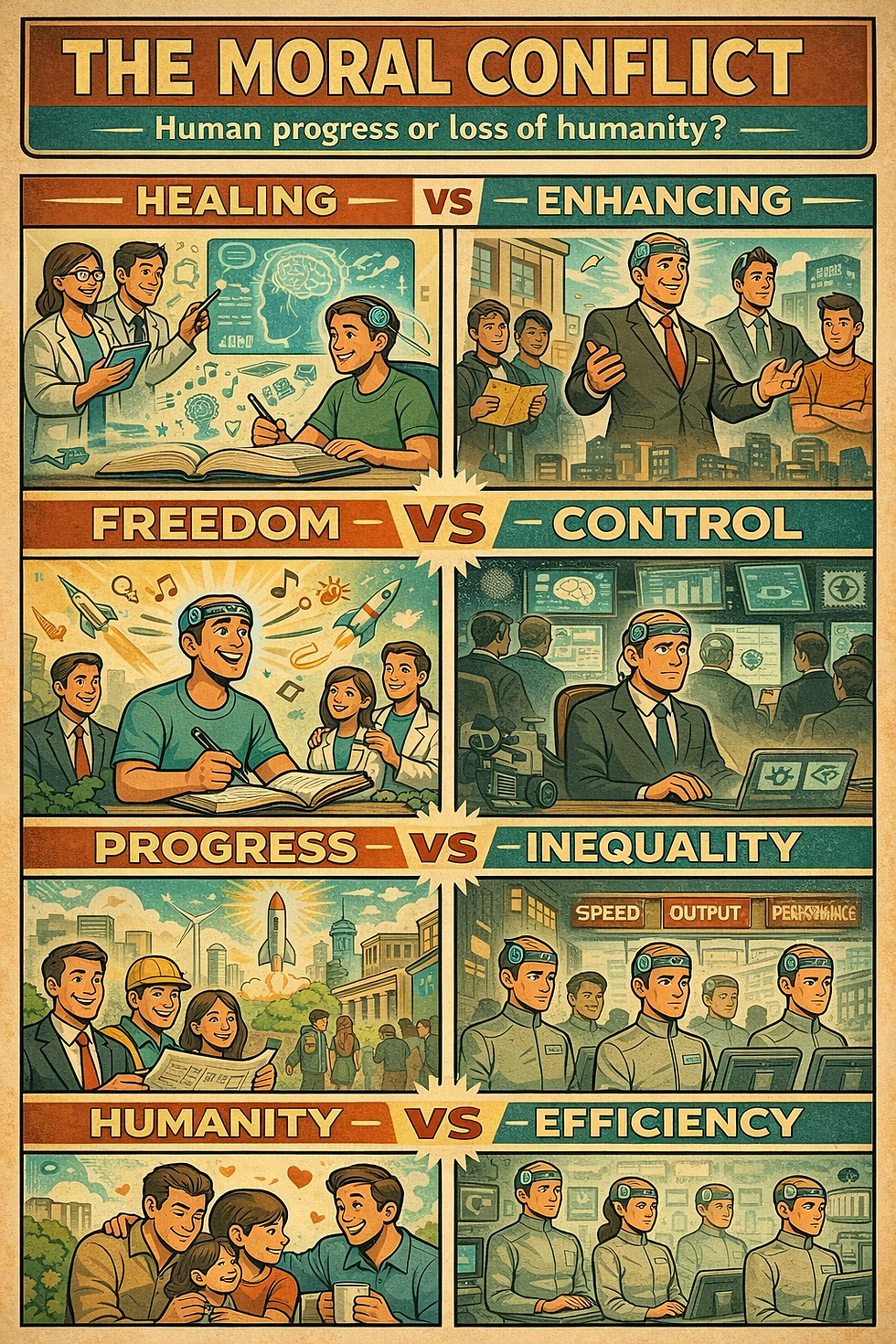
Since all possibilities for enhancing the brain have been discussed, we can now examine the results of this technology. Neuroplasticity boosters may help those with disabilities and special needs. In society, intelligence can influence success in academics, jobs, social status, and more. A society with widespread brain enhancement could undergo drastic changes. For instance, school might become unnecessary, as everyone could be “smart.” Effort might decline, as people would no longer need to work hard when brain enhancement provides instant results. Intelligence would become the central ideal, respected above all else. Emotions could be seen as an annoyance, and emotionally attached objects—family members, friends, favorite foods—might be disregarded.
Succumbing to a purely intellectual life, people may behave like robots, operating without emotions. Many would then question how society could be governed if everyone were smart. The answer is simple: elites, likely connected to businesses that develop brain-enhancement technologies, would maintain control. No one would have guaranteed security over their own body, despite propaganda from BCI companies. BCIs could violate privacy by tracking behavioral data, thought processes, and personal information. Governments might comply because this strengthens their stability. By understanding people’s interests through collected data, governments and elites would cooperate with BCI companies, keeping public suspicion low.
The lesson here is that society should not exceed the limits of human nature. When humans manipulate intelligence—a gift—there is a high chance of exploitation. History shows similar patterns, such as during the Industrial Revolution. Technological advancements allowed new achievements, but also created issues like monopolies and environmental damage. Every technological leap comes with trade-offs.
We are entering an era where the definition of “human” is no longer fixed. Whether Human-Brain Enhancement leads to a robotic, controlled society or a golden age of problem-solving remains uncertain. What is certain is that we are the last generation to define intelligence solely by biological luck. From this point onward, intelligence will be a matter of design.


Comments